Workholding Devices for Productivity & Precision
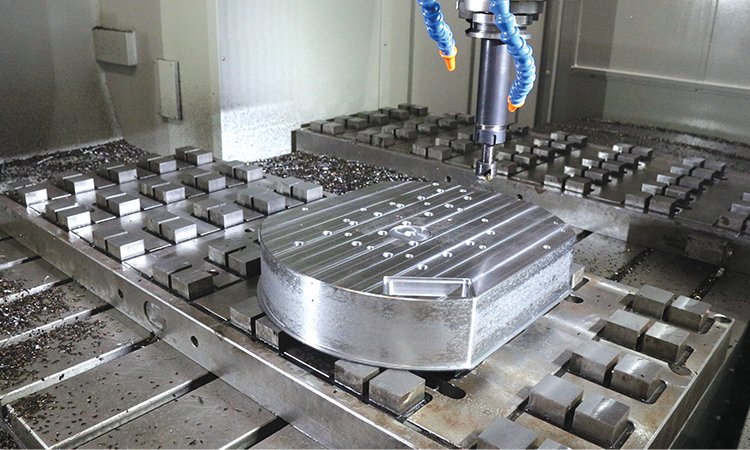
In machining, the cutting tool often takes center stage as the key to precision and productivity. Yet, an equally important element is sometimes overlooked—the workholding device. Without effective work holding, even the most advanced CNC machine and cutting tool cannot deliver the required accuracy or productivity. Workholding devices ensure that the workpiece is rigidly supported, correctly aligned, and securely clamped during machining operations. As manufacturing evolves toward higher speeds, tighter tolerances, and automation, the role of workholding has become even more critical.
The Importance of Workholding in Modern Manufacturing
Workholding serves two fundamental purposes:
- Positioning: Ensuring the workpiece is located correctly relative to the tool.
- Clamping: Securing the workpiece against movement or vibration during machining.
The right workholding device not only ensures part accuracy but also:
• Enhances surface finish.
• Extends tool life by reducing chatter.
• Reduces setup time, leading to higher productivity.
• Enables multi-axis machining & automation.
As tolerances shrink and cycle times shorten, manufacturers increasingly rely on advanced workholding solutions to meet these demands.
Traditional Workholding Devices
1 Vises
Machine vises are among the most common and versatile workholding tools.
2 Standard Vises
Ideal for milling operations.
3 Precision Vises
Provide higher accuracy for toolroom and inspection work.
4 Modular Vises
Can be configured for different part sizes and shapes.
2 Chucks
Chucks hold cylindrical parts securely and are widely used in turning and grinding.
• Three-Jaw Chucks: Self-centering, quick setup for round workpieces.
• Four-Jaw Independent Chucks: Greater flexibility for irregular shapes and eccentric turning.
• Collet Chucks: Offer superior concentricity and grip for smaller components.
1 Faceplates
Faceplates are flat, circular plates used on lathes to hold irregularly shaped workpieces with clamps and bolts.
2 Fixtures
Fixtures are custom or semi-custom devices designed to hold specific workpieces. They are particularly important in mass production where repeatability is vital.
3 Angle Plates and Clamps
These simple but effective devices support workpieces at angles and are widely used in both milling and drilling setups.
Advanced Workholding Devices
Magnetic Workholding
Electromagnetic and permanent magnetic chucks enable quick clamping of ferrous materials. They are especially useful for flat or thin components that may be difficult to clamp mechanically.
Hydraulic and Pneumatic Workholding
Hydraulic and pneumatic clamps provide consistent clamping force and can be integrated with CNC machines for automation. They reduce setup time and operator fatigue.
Zero-Point Clamping Systems
Zero-point clamping systems allow for extremely fast workpiece changes, often within seconds. They rely on a base plate with standardized clamping points, enabling workpieces or fixtures to be swapped quickly and repeatably.
Modular Fixturing Systems
These systems use standardized components like plates, locators, and clamps that can be assembled into custom fixtures. They combine flexibility with precision and are invaluable in prototyping and low-volume runs.
Vacuum Workholding
Vacuum chucks hold non-ferrous materials such as aluminum, composites, and plastics by suction. They are ideal for flat parts and delicate materials where mechanical clamping could cause distortion.
Workholding in Multi-Axis and CNC Machining
With the advent of 3-, 4-, and 5-axis machining centers, workholding has become more sophisticated. Devices must allow maximum access to the workpiece while maintaining rigidity.
• Trunnion Tables: Allow parts to be rotated for multi-axis machining.
• Self-Centering Vises: Provide uniform clamping for symmetrical parts.
• Custom Fixtures with Rotary Couplings: Support simultaneous machining on multiple faces.
Automation is driving another leap forward. Robotic workholding and pallet changers allow machines to run lights-out, significantly increasing productivity.
Materials and Design Trends in Workholding
Workholding devices are now designed with lightweight but strong materials such as aluminum alloys, composites, and high-strength steels. Finite element analysis (FEA) is often applied in design to ensure rigidity while minimizing weight. Coatings and surface treatments are also used to improve wear resistance.
Another trend is integration of sensors into workholding devices. These sensors can monitor clamping force, detect part presence, and even relay data to machine controllers for adaptive machining strategies.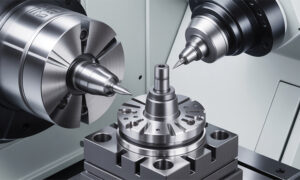
The Balance: Productivity vs. Precision
The choice of workholding often involves balancing productivity and precision. For example:
• A three-jaw chuck offers speed but less precision compared to a collet chuck.
• Custom fixtures provide accuracy but may be time-consuming to design and expensive to build.
• Zero-point clamping maximizes productivity in environments where parts must be changed rapidly.
In high-volume automotive production, dedicated fixtures ensure consistency and throughput. In aerospace, modular and adaptive systems are preferred to handle complex geometries & lower batch sizes.
Challenges in Workholding
Despite advancements, workholding still presents challenges:
• Complex Geometries: Irregular or thin-walled parts can be difficult to hold without distortion.
• Cost of Custom Fixtures: For small batches, the cost of dedicated fixtures may outweigh benefits.
• Heat and Vibration: Can affect clamping integrity in high-speed machining.
• Material Diversity: Composites, ceramics, and advanced alloys require specialized workholding approaches.
Future of Workholding
The future of workholding lies in smart systems that combine automation, digitalization, and flexibility. Trends include:
• Sensor-Integrated Workholding: Real-time feedback on clamping force and alignment.
• Additive Manufacturing for Fixtures: Lightweight, custom designs produced quickly and cost-effectively.
• Adaptive Clamping: Fixtures that automatically adjust to different geometries without manual intervention.
• Sustainability: Energy-efficient hydraulic/pneumatic systems and re-usable modular fixturing.
As Industry 4.0 and lights-out manufacturing become mainstream, workholding will continue to evolve from being a supporting element to a strategic enabler of productivity and precision.
Conclusion
Workholding devices may not always be as glamorous as cutting tools or CNC machines, but their role in modern manufacturing is undeniable. They bridge the gap between machine capability and workpiece accuracy, ensuring productivity and precision go hand in hand. From simple vises to advanced zero-point clamping and sensor-equipped fixtures, the spectrum of solutions available today allows manufacturers to choose devices that perfectly match their needs. As machining moves into the era of smart, connected, and sustainable manufacturing, workholding will play an increasingly pivotal role—not just in holding parts, but in holding together the promise of precision engineering.